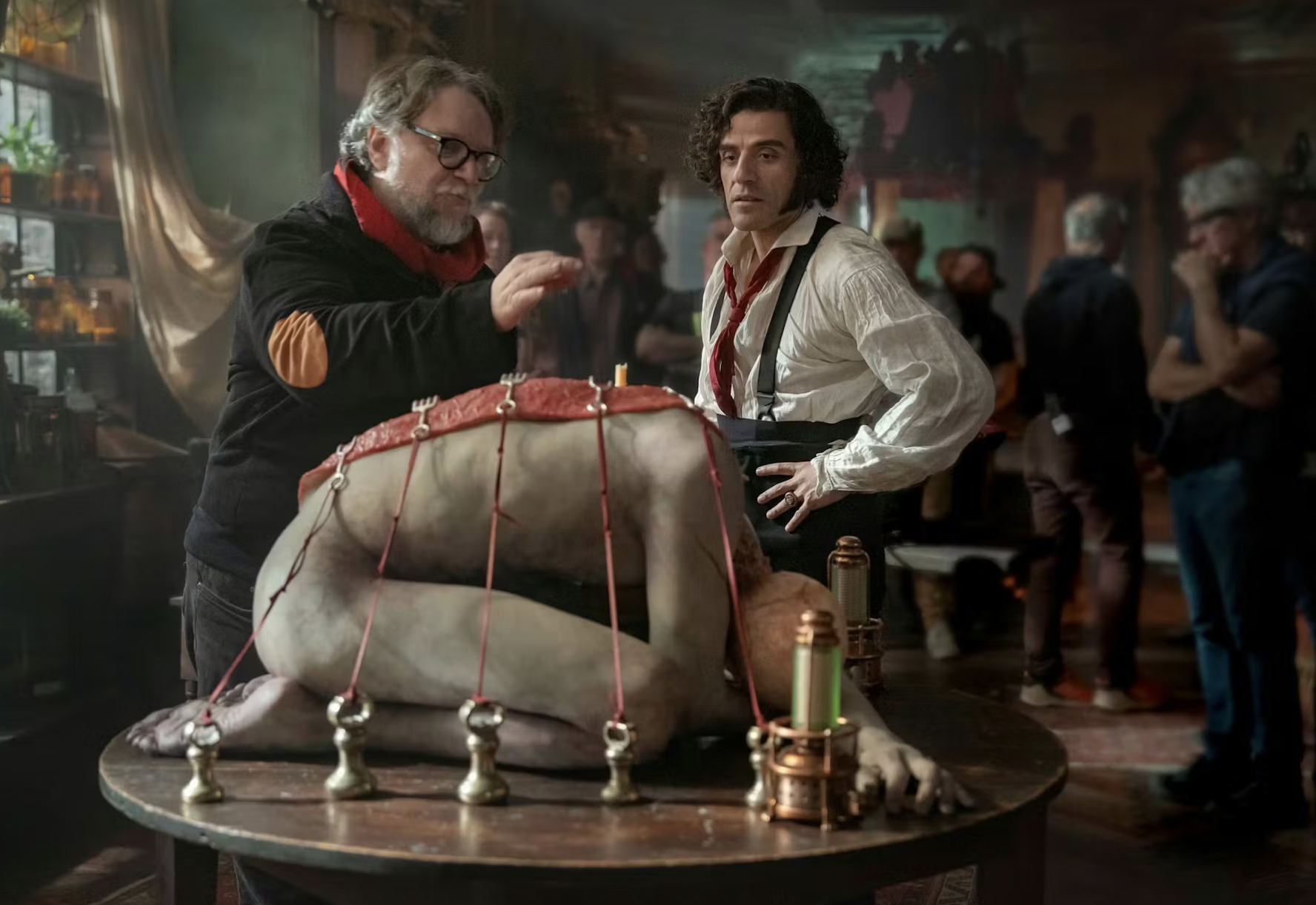
“Frankenstein” premiered on Oct. 17 in limited theatres before its official release on Netflix Nov. 7. Director Guillermo Del Toro stands out from current industry standards as being very against AI and wanting real sets made by real people. From the open-faced coffins to the gory Catholic imagery, everything is intentional. Frankenstein is a monster movie with themes of life, death, friendship, and parenthood.
With over 30 years of filmmaking experience, Del Toro has finally adapted Mary Shelley’s “Frankenstein”. During his childhood, he would attend film screenings after church. It has been a lifelong dream to direct a film based on this story. The film is divided into two parts: Victor’s Tale and the Creature’s Tale. Victor Frankenstein’s point of view begins with his mother and her early departure. Frankenstein believes his father hated him and that his mother shared his dark hair and eyes. His younger blonde brother is heavily favored by the father, which can be read as a nod to colorism prevalent in Mexican communities. His father is a strict disciplinarian who often hits him when he is inaccurate in his studies.
In his father’s absence, Frankenstein finds solace in his mother. The death of his mother sends him on a lifelong mission to conquer death. After the death, Frankenstein receives a vision from the red statue of the family’s Archangel. Frankenstein becomes hellbent on conquering death and proving his father wrong. He also takes on the color his mother wore most, red, the color of his childhood. In adulthood, he wears her red gloves and is regularly shown drinking milk.
The Archangel was handcrafted, and as Del Toro notes, “I wanted it to look like a Mexican, a sort of colonial Archangel.” The pageantry of the Catholic elements that are very Mexican, and the melodrama of father and son, are very Mexican.
The Creature’s birth is theatrical and operatic. There is precision in the process, with Frankenstein visiting bloodied battlefields and attending public executions for the perfect parts. Lightning, thunder, and camera shots accompany the Creature’s birth. Big cranes were used for many wide-angle shots throughout the film. Before the resurrection, the corpse stands in a cross-like pose, reminiscent of Jesus Christ, not entirely human, who died but was resurrected.
After bringing the Creature to life, Frankenstein suffers from a sort of post-partum depression. ‘I never considered what would come after creation.’ Frankenstein’s lack of preparation leads to frustration and anger with his newfound fatherhood. He channels his father by lashing out and hitting the Creature, blaming him for his rage. The generational cycle of abuse is repeated within the Creature and Frankenstein’s relationship. The Creature fears his maker, leaving Frankenstein to blame him for the said fear.
While directing Oscar Issac Del Toro asked him to channel Mexican telenovelas by delivering his lines with more drama. This is demonstrated with Victor’s seething jealousy, witnessing the connection between the Creature and Elizabeth, his brother’s fiancée, who repeatedly rejects him. Elizabeth is the first person to see the Creature as a human, not a monster. Something that Victor failed to achieve for both his creation and the object of his affections.
The Creature’s Tale begins around halfway through the runtime. It follows the Creature as he was abandoned by Victor and his journey in finding who he is and why he is feared. He befriends a blind man who teaches him how to read, and is shown kindness after the lingering effects of Frankenstein’s abuse.
The Creature discovers the reason why he sees memories that are not his is that he’s the product of several mangled corpses. He tracks down Frankenstein and learns that Frankenstein cannot die and wishes for a companion. ‘We can be monsters together,’ Frankenstein taunts him and refuses, and does not see the Creature as a person but as a mistake he made.
The Creature becomes violent, and they continue with a game of cat and mouse: Frankenstein failing to kill the Creature, the Creature unable to die yet wishing for death and harming Frankenstein instead.
In the end, they have a reconciliation on Victor’s deathbed. The Creature has no rage left. Frankenstein apologizes, acknowledges him as his son, and asks him to live. The film ends with forgiveness, an end to the cycle of pain and abuse, and a renewal of life.