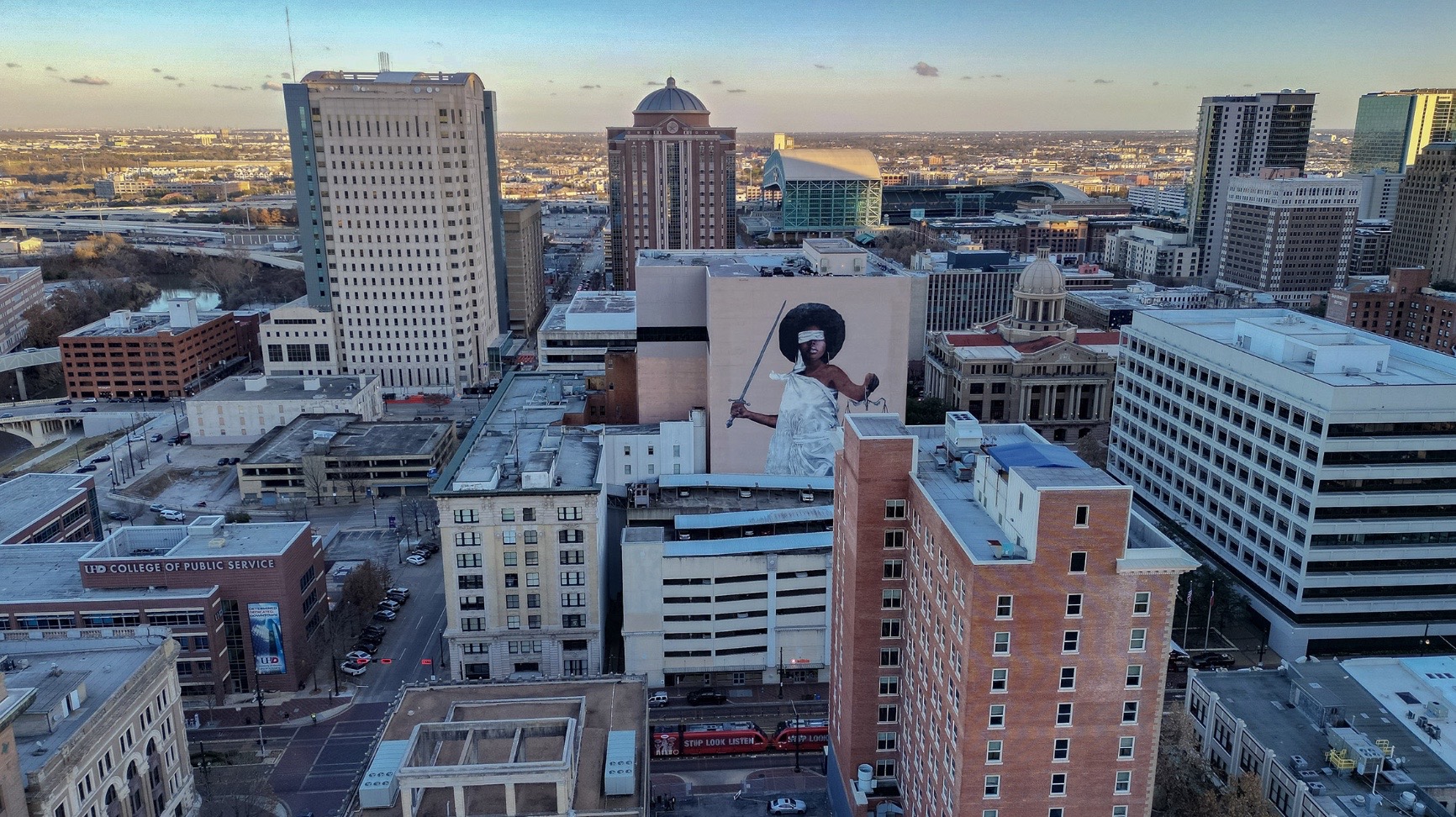
Gazing across downtown Houston from a seat on the 10th floor of the Academic Building, you take in the city bathed in the glow of the setting sun. Glass towers catch the fading light, reflecting streaks of orange and gold across the skyline. Your eyes settle on a towering rendering of a Black Lady Justice. Set against the building’s concrete facade, she wears a white scarf tied over her eyes, a sword in one hand and the scales of justice in the other. She overlooks Congress Plaza and the courthouse complex as an unwavering defender of fair, impartial justice for all.
The mural’s significance extends beyond its striking visual impact. This work is one half of the “Remembrance” diptych, created as a point of reflection on justice and fairness and a catalyst for discourse.
This artwork, along with several others that now adorn the landscape of the downtown area, is part of the city’s “Big Art. Bigger Change.” initiative. The project aims not only to beautify the heart of the city through art, but also to raise awareness of social and environmental justice issues, particularly those aligned with the United Nations’ Sustainable Development Goals.
The idea took root during a conversation at an earlier mural unveiling between Harris County Commissioner Rodney Ellis and founders of Street Art for Mankind, Audrey and Thibault Decker. Together with Central Houston Inc. and the Danish-French artist Victor Ash, they brought the concept to life.
At its core, the Remembrance murals are part of a broader effort to confront and recover from the city’s history of racial violence. The Harris County Remembrance Project, led by Ellis in collaboration with the Equal Justice Initiative, the Afro-American Historical and Genealogical Society, Inc., and Friends of the African American Library at the Gregory School, seeks to memorialize the legacy of racial injustice in the region.
The project honors four Harris County lynching victims — John Walton, Bert Smith, John White and Robert Powell — documented by the Equal Justice Initiative in its 2014 report chronicling racial terror lynchings across the United States, “Lynching in America: Confronting the Legacy of Racial Terror.”
In addition to the transformation of Quebedeaux Park into Remembrance Park, the memorial spans three city blocks from Congress Street to Buffalo Bayou. It unfolds across three distinct but interconnected elements. The first focuses on education, offering reflective spaces designed for gathering and learning. The second centers artistic expression, inviting engagement through multidimensional and multimedia works. The third emphasizes restoration, envisioning a renewed waterfront with immersive, nature-based spaces for healing and play.
The symbolism of Lady Justice is further deepened by her placement. “The county attorney’s building is on one of the most popular slave auction trading blocks in Houston,” Ellis told Ashley Brown in a 2023 Houston Public Media article. “That in part is why I thought that these two women, female features would be important to be on this building.”
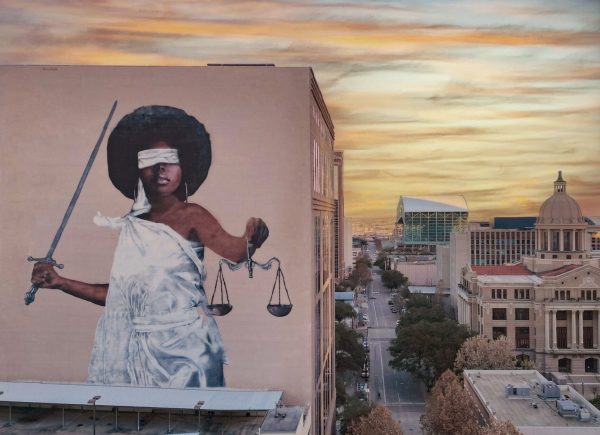
For those who pass through the plaza each day, the mural exists in quiet dialogue with its surroundings. It does not allow the past to remain distant. In this way, the mural becomes more than a work of art. It stands at the intersection of past and present, confronting a history often left unspoken while asserting a vision of justice that is visible, inclusive and accountable.
“I thought it was important to have the display right there in front of the Harris County Courthouse because, not only does it commemorate the sacrifices that these people made that have died in such an awful, horrendous set of circumstances, but also to make the point that we’re committed to due process, to equal protection under the law,” Ellis told KHOU 11 reporters Adam Bennett and Michelle Homer.
As the sun sets over downtown Houston, the city glows. Light moves across glass and stone, across streets layered with history. And there she remains — Lady Justice — not removed from history but instead grounded in it. Bearing witness to what has been and what is still unfolding. She beckons those who gaze up at her not only to see, but to reflect, to question and to imagine a more just future.